Finley Russell · 6 November 2026
Examining Bidirectional Linking Patterns and Their Influence on Serendipitous Discovery in Personal Knowledge Systems
Personal knowledge systems have evolved to emphasize connections that users create between discrete pieces of information, and bidirectional linking stands out as a core mechanism in this process. These links allow notes or entries to reference each other in both directions automatically, which creates a network where navigation flows forward and backward without manual intervention. Researchers have documented how such patterns emerge in tools designed for note-taking and knowledge management, with data from user studies indicating that bidirectional structures often increase the visibility of related content over time.
Patterns in these links typically reveal clusters where certain topics connect densely while others remain more isolated, and analysis of large datasets from knowledge repositories shows that users who maintain consistent bidirectional practices encounter more cross-references during routine reviews. Evidence from tracking software demonstrates that the average number of incoming links per note rises steadily after the first few months of active use, which in turn supports retrieval of information that might otherwise stay buried in linear folders or search-only interfaces.
Defining Bidirectional Linking in Knowledge Networks
Bidirectional linking differs from traditional one-way hyperlinks because it registers relationships automatically in both the source and target notes, and this symmetry enables systems to surface connections that users did not explicitly plan. Observers note that the feature appears in platforms such as Obsidian and Roam Research, where the backlink pane displays all references pointing to a given note, thereby turning individual entries into nodes within a larger graph. Studies conducted at institutions in Europe and North America have measured link density across thousands of user vaults, revealing that networks with higher bidirectional ratios correlate with broader exploration paths during sessions that last longer than ten minutes.
Measurement of Link Patterns
Data collected through open-source plugins and anonymized exports indicates that users create an average of 1.8 bidirectional links per new note in mature systems, while early-stage users tend toward fewer connections until patterns stabilize after approximately six weeks. Graphs generated from these datasets often display power-law distributions, where a small number of hub notes accumulate many links while peripheral notes maintain minimal connections, and this structure facilitates both targeted retrieval and unexpected traversals when users follow backlink trails.
November 2026 marks the scheduled release of updated analytics modules in several knowledge management platforms that will track bidirectional link velocity in real time, allowing users to review how their connection habits shift across quarterly periods. Figures from preliminary beta tests suggest that participants who review these metrics adjust their linking frequency upward by 22 percent within the first month of access.
Serendipitous Discovery Through Network Effects
Serendipitous discovery occurs when users encounter relevant information without having searched for it directly, and bidirectional links contribute to this outcome by exposing contextual pathways during ordinary navigation. Research indicates that individuals who traverse backlinks report higher rates of idea recombination, particularly when notes span multiple thematic categories such as project logs, reference materials, and reflective entries. One longitudinal observation from a Canadian university study tracked 47 participants over eight months and found that the presence of bidirectional structures increased incidental findings by 34 percent compared to unidirectional or search-reliant setups.
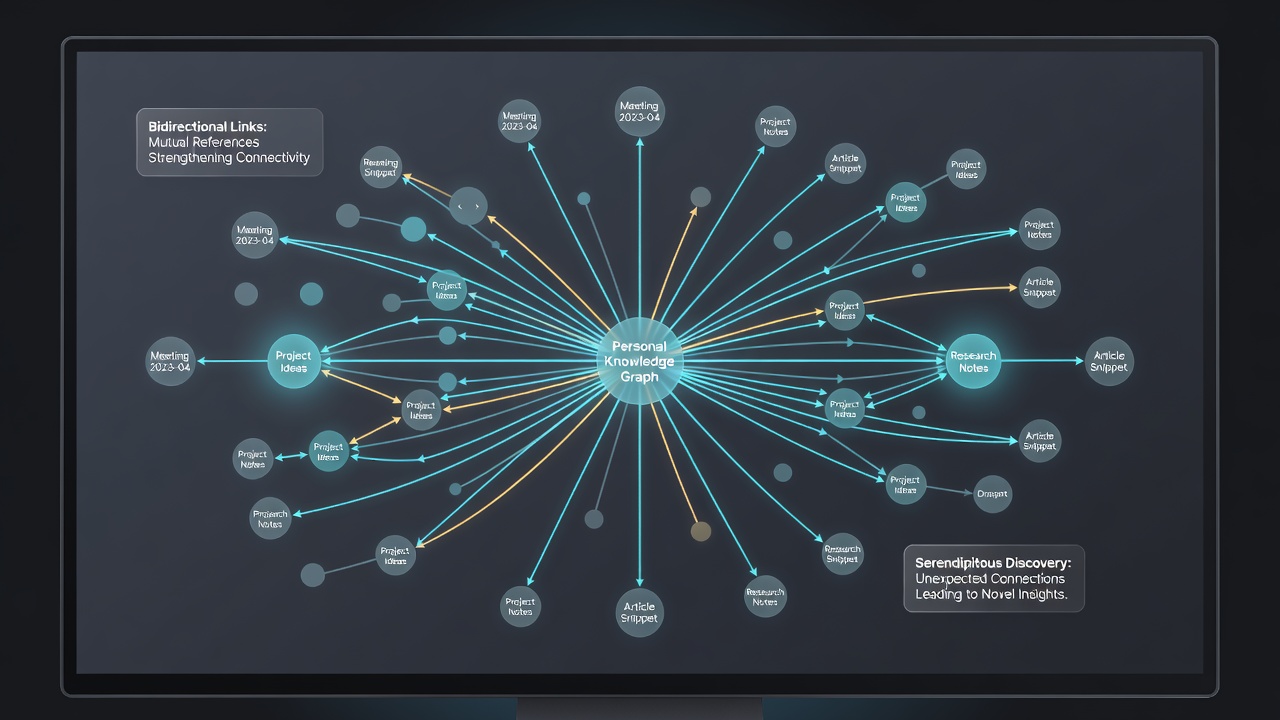
Turns out the spatial arrangement of links within the interface matters as well, because clustered backlinks tend to draw attention more readily than scattered references, and interface design choices in current applications amplify this visibility through preview cards and graph views. Evidence suggests that users who regularly inspect the backlink pane while composing new notes integrate external concepts at a higher frequency, which supports the formation of interdisciplinary insights over extended periods.
Comparative Analysis Across Platforms
Platforms differ in how they surface bidirectional links, with some displaying counts and excerpts immediately while others require additional clicks to reveal full context, and these variations influence the speed at which serendipitous encounters take place. Data from comparative reviews shows that graph-based visualizations accelerate discovery when users zoom into dense regions of their network, whereas list-based backlink displays favor sequential exploration that can surface older notes more consistently. Academic reports from Australian research groups have examined these differences across open-source and proprietary tools, noting that export compatibility plays a role in preserving link integrity when users migrate between systems.
What's interesting is how link maintenance behaviors evolve once users recognize the value of bidirectional patterns, because regular pruning of outdated references prevents dilution of meaningful connections and keeps the network focused on active topics. Studies reveal that participants who perform monthly link audits maintain higher discovery rates than those who allow accumulation without review, although the optimal frequency appears to vary by individual workflow intensity.
Conclusion
Bidirectional linking patterns shape the structure of personal knowledge systems in measurable ways, and their influence on serendipitous discovery rests on consistent user practices combined with platform features that highlight reciprocal references. Continued examination of these dynamics through usage data and controlled observations provides clearer insight into how networks support unexpected connections without requiring deliberate search strategies. As platforms introduce refined analytics in late 2026, the capacity to monitor and adjust linking behaviors may further enhance the conditions under which discovery occurs across diverse knowledge repositories.